



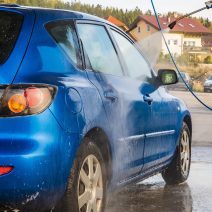


When you buy a car, either brand new or second hand, you will find a manual in the vehicle that tells you what car engine oil you need. Your vehicle will require an oil top up at 180,000km or when your motor oil light appears. You can also check your car oil by ensuring it has not been turned on for at least an hour. Take the dipstick out and wipe it clean. Dip it back into the oil and see if it covers the oil markers. If it doesn’t, then it’s time to top up your oil.
If you are like me – you want to know more about the oil and what the numbers and letters mean on the bottle – here is a brief explanation. Equally, you can log on to several websites that can advise you on what oil you need, based on the make and model of your car.
Viscosity means a fluid’s resistance to flow. In motor oil, it’s rated at zero degrees Fahrenheit (represented by the number preceding the “W” for winter) and at 212 degrees (represented by the second number in the viscosity designation).
Motor oil thins as it heats and thickens as it cools. So, with the right additives to help it resist thinning too much, an oil can be rated for one viscosity when cold, another when hot. The more resistant it is to thinning, the higher the second number (10W-40 versus 10W-30, for example), and that’s good. Within reason, thicker oil generally seals better and maintains a better film of lubrication between moving parts – and this is what you want to keep your car, a bit like ensuring the bones and joints in the human body are lubricated to stop aches/pains and arthritis.
Low Temperature
At the low-temperature end, oil has to be resistant to thickening so that it flows more easily to all the moving parts in your engine. Also, if the oil is too thick, the engine requires more energy to turn the crankshaft, which is inside a bath of oil. Excessive thickness can make it harder to start the engine, which reduces fuel economy. A 5W oil is what recommends for winter use. However, synthetic oils can be formulated to flow even more quickly when cold, so they can pass tests that meet the 0W rating.
Example Temperature
Once the engine is running, the oil heats up. The second number in the viscosity rating—the “40” in 10W-40, for example—tells you that the oil will stay thicker at high temperatures than one with a lower second number—the “30” in 10W-30, for example. What’s important is that you use the oil viscosity your car’s owner’s manual recommends.
In temperatures that soar past the 40 degrees in the UAE, it’s always wise to purchase an oil that ends in 40 – or you can ask a professional or go to one of our partners like Profix Autocare and have them change your oil.



















































Your point of view caught my eye and was very interesting. Thanks. I have a question for you.
Your point of view caught my eye and was very interesting. Thanks. I have a question for you.
I don’t think the title of your article matches the content lol. Just kidding, mainly because I had some doubts after reading the article.
Thanks for sharing. I read many of your blog posts, cool, your blog is very good.
Your point of view caught my eye and was very interesting. Thanks. I have a question for you. https://www.binance.info/uk-UA/register?ref=W0BCQMF1
Thank you for your sharing. I am worried that I lack creative ideas. It is your article that makes me full of hope. Thank you. But, I have a question, can you help me? https://accounts.binance.com/register-person?ref=IXBIAFVY
Thanks for sharing. I read many of your blog posts, cool, your blog is very good. https://www.binance.info/es-MX/register?ref=GJY4VW8W
Your point of view caught my eye and was very interesting. Thanks. I have a question for you.